




A website redesign involves rethinking a site’s design, structure, and technical foundation to improve its performance. Poorly planned, it can lead to a loss of traffic and leads. Here is the complete method to make your redesign succeed without SEO impact.
What is a successful redesign?
A website redesign that succeeds improves the site without causing traffic or leads to drop. It can be visual, structural, or technical, but the goal remains the same: better serve your visitors and your business objectives.
A visual redesign changes the visual identity, components, and readability. A structural redesign reworks the site architecture, pages, and user journeys. A technical redesign, meanwhile, affects the CMS, performance, and maintenance. In the projects we scope at mad.studio, the right outcome often combines these three levels, but not always to the same degree.
So the right benchmark is not “make it prettier.” It is making the site more useful, easier to maintain, and more effective at converting. A site can look modernized while still being slow, poorly organized, or fragile from an SEO standpoint.
- A visual redesign improves brand perception.
- A structural redesign reduces navigation friction.
- A technical redesign secures performance and updates.
- A conversion-oriented redesign aligns pages with business goals.
In practical terms, a successful redesign is measured by continuity. Important content remains accessible, valuable rankings are preserved, and key journeys become clearer. This combination is what sets a simple refresh apart from a true redesign project.
Why launch a website redesign now?
A redesign should be launched when weak signals are visible on the site, in the data, or in day-to-day operations. Waiting too long increases the cost of fixes and the risk of performance loss.
The right moment is often revealed by concrete symptoms: pages becoming difficult to update, declining conversion, SEO debt, slow load times, or brand inconsistencies. To decide quickly, we think in terms of signal, risk, and priority.
| Signal | Risk if we wait | Action priority |
|---|---|---|
| The site is no longer easy to update | Strong dependency on technical support and longer internal lead times | Start scoping a structural redesign |
| Organic traffic is flat or declining | Progressive loss of visibility on strategic pages | Prepare an SEO migration with URL audit |
| Forms generate few contacts | The site attracts visitors, but does not convert enough | Review journeys and calls to action |
| The design no longer reflects the brand | Gap between positioning and commercial perception | Rethink the interface and messaging |
| Teams work around the CMS | Loss of consistency and more fixes | Choose a more suitable, often more flexible, foundation |
This reading prevents a simple refresh from being mistaken for a real overhaul. A redesign is not a luxury when the site is blocking marketing teams or slowing down the sales cycle.
With mad.studio, we often see that projects triggered by a single problem actually reveal several linked weaknesses: confusing site structure, scattered content, incomplete tracking, and slow production. That is why an initial diagnosis is more useful than a simple gut feeling.
Scoping the project and expected deliverables
The scoping phase of a website redesign must produce precise deliverables before any visual production begins. Without that, trade-offs come too late and revisions pile up at the end of the project.
We usually move forward in phases, with a level of detail that depends on the context, budget, and number of stakeholders. For a project run with a dedicated team, this method avoids losing the big picture while maintaining a strong pace of execution.
Initial audit and measurable objectives
The starting point is to measure what is really happening on the site. We look at traffic, entry pages, conversions, exit areas, mobile behavior, and technical constraints.
The audit also helps formulate observable objectives. For example, reducing bounce rate on service pages, increasing qualified contact requests, or improving the ranking of key pages in organic search.
- Analyzing the SEO performance of the main pages.
- Identifying UX friction points on priority journeys.
- Spotting the technical limits of the current CMS.
- Linking the site’s goals to business goals.
In our projects, the audit serves as the foundation for everything else. It is the type of deliverable that mad.studio structures from the first weeks to avoid blind spots.
Site structure, wireframes, and content priorities
A clear site structure organizes the site around user needs and business priorities. Wireframes turn that logic into page structure, without locking in the design yet.
At this stage, we decide what to keep, what to merge, and what to simplify. The most useful content must be visible, accessible, and designed for conversion before being visually styled.
- Prioritize pages according to their role in the journey.
- Reduce content duplication.
- Place proof points, benefits, and CTAs in the right places.
- Define the essential blocks on each template.
When the project requires tighter scoping, it is necessary to build a team that adapts to the need: design, content, SEO, and development must move together. This is especially true for marketing sites with multiple decision-makers.
Specifications, testing, and internal validation
Specifications prevent delivery ambiguities. They describe the components, expected behaviors, responsibilities, and validation criteria.
Internal testing then checks that the site truly matches the scoping. It must cover both the visual output, the features, and edge cases before going live.
- Formalize functional and editorial rules.
- Validate templates, states, and variants.
- Check blocking issues before final integration.
- Sign off on testing with the relevant teams.
This level of precision is what a marketing team expects when it wants to deliver quickly without multiplying back-and-forth. For this kind of phase, mad.studio centralizes scoping and production in the same workflow.

Choosing the right CMS / Webflow pairing
The right choice depends on the expected level of autonomy, site complexity, and publishing pace. A classic CMS suits very large editorial structures, while Webflow often speeds up the production of more agile marketing sites.
The issue is not “Webflow or not Webflow” in the abstract. The main thing is to choose a foundation that allows the team to edit, evolve pages, and maintain a good level of quality without depending too often on development.
In a marketing-oriented redesign project, Webflow can be relevant when you want to combine speed of execution, design freedom, and update autonomy. That is precisely the space where our team at mad.studio often operates: the site must remain flexible without becoming fragile.
- A robust CMS remains useful for very large site structures.
- Webflow is well suited to showcase, institutional, and B2B sites.
- Heavy development is not always necessary to achieve performance.
- Editorial autonomy matters just as much as visual quality.
| Business need | Usually suitable choice | Why |
|---|---|---|
| Frequent updates by marketing | Webflow | Fast editing, reusable components, good readability |
| Very dense editorial catalog | Classic CMS | Handling many content types and advanced roles |
| B2B website redesign with clear journeys | Webflow | Fast delivery and design control |
| Already highly integrated tech stack | Existing or hybrid CMS | Reduced impact on the current information system |
The right trade-off is still the one that serves the real project, not the one that looks impressive on paper. When the need is to move fast with a high level of polish, a dedicated Webflow team can simplify execution without adding organizational weight.
Preparing SEO migration and redirects
SEO migration is the most sensitive part of a redesign. It protects earned visibility by organizing URLs, content, and redirects before production launch.
A good migration does not stop at “adding 301s.” It requires a clean inventory, logical mappings, internal linking checks, and monitoring after launch.
Mapping the pages to keep, merge, or remove
The URL inventory is used to decide which pages should remain, merge, or disappear. This step avoids multiplying duplicates and needlessly transferring weak content to the new site.
The rule is simple: pages that drive traffic, links, or conversions must be handled first. The others should be consolidated if they provide real documentation value.
- Identify the most visible organic pages.
- Spot low-value or outdated content.
- Merge pages that cover the same topic.
- Keep strong URLs whenever possible.
With mad.studio, we see that sites that prepare this mapping early handle the switch better. Teams also save time on editorial cleanup.
Building redirects and preserving internal linking
Redirects must follow a precise one-to-one matching logic, page by page. A redirect that is too broad or poorly targeted degrades the experience and can dilute SEO relevance.
Internal linking must be updated in parallel. Otherwise, the site keeps sending contradictory signals to search engines and visitors.
| Case | Expected action | Desired effect |
|---|---|---|
| Old page kept under a new URL | Direct 301 redirect | Preserve history and traffic |
| Two pages merged into one | Redirect to the consolidated page | Avoid cannibalization |
| Deleted page with no equivalent | Send to the closest page | Limit value loss |
| Outdated internal links | Update anchors and URLs | Reduce errors and smooth crawling |
This step is often underestimated, even though it determines launch stability. This is also where tracking the migration on a complex site becomes truly meaningful: impacts must be checked across several layers, not just on visible pages.
Checking launch and fixing quickly
After launch, the first checks should focus on indexing, redirects, errors, and conversions. Issues caught early cost far less to fix.
This phase is short, but decisive. A site can look fine on the surface while losing rankings or breaking important journeys.
- Check response codes for the main pages.
- Verify that redirects point to the correct destinations.
- Compare traffic and conversions before and after launch.
- Fix broken links and tracking issues.
The useful reflex is to keep a close monitoring window for the first few days. After that, analysis shifts to trends, using Search Console, analytics, and form data.
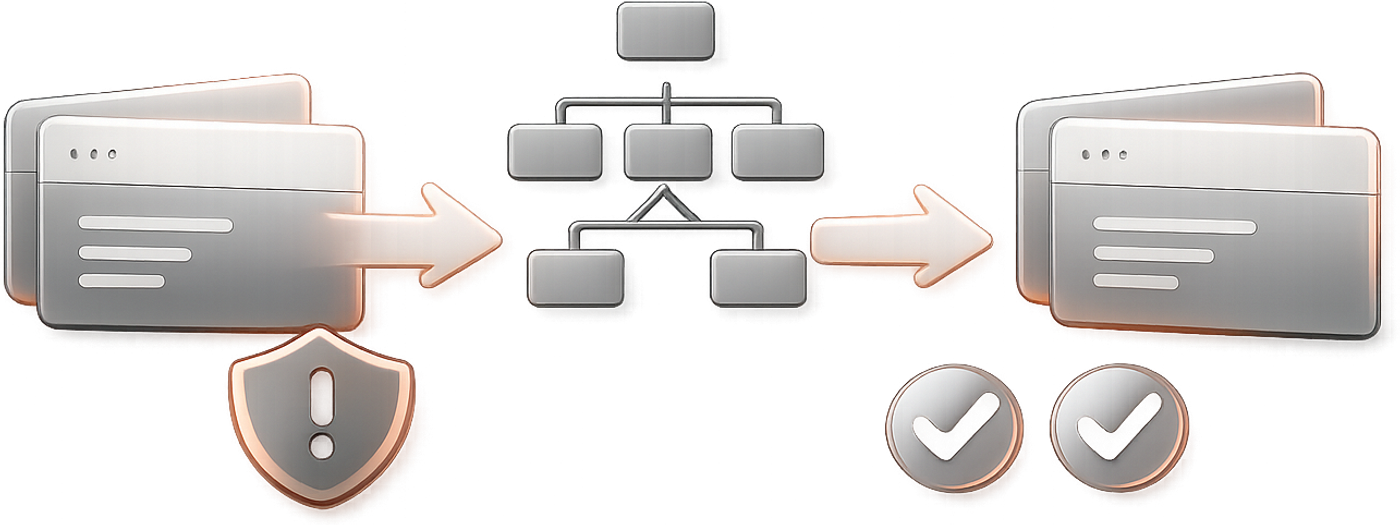
Website redesign checklist (before, during, after)
Here is a checklist to approach the redesign calmly and avoid costly oversights at launch.
Before
- Inventory the URLs to keep, merge, or remove.
- Verify the redirects needed for each affected page.
- Check tracking and the main measurement events.
During
- Validate the testing of templates, content, and features.
- Test key journeys on desktop and mobile.
- Verify that redirects work as expected.
After
- Monitor indexing, errors, and strategic rankings.
- Track traffic, conversions, and forms.
- Quickly fix anomalies detected during monitoring.
Mistakes to avoid during a website redesign
A high-performing redesign is not just about modernizing the design. It is mainly about avoiding the mistakes that break visibility, journeys, and measurement.
- Forgetting redirects while old URLs continue to exist.
- Changing the structure without an audit, which weakens the site architecture and content priorities.
- Breaking tracking by launching the new site without checking events and conversions.
- Launching without testing, with bugs that appear once the site is live.
These mistakes have an immediate impact on launch quality, but also on how the project is perceived in the long term. Avoiding them increases perceived value and covers long-tail SEO queries very close to the intentions of teams preparing a redesign.
B2B conversion-oriented redesign
A B2B redesign must convert better, not just tell a better story. Visitors are looking for proof, quick answers, and journeys that reduce the effort required to get in touch.
Service pages, client cases, forms, and CTAs must therefore be designed together. If each of these blocks plays its role, the site becomes a real sales tool.
The starting point is simple: the page must reassure, clarify, and guide. We often work on this trio with marketing teams that want a site that is easier to read for busy decision-makers.
- Make the value proposition understandable in a few seconds.
- Show concrete proof and measurable results.
- Reduce the number of steps before contact.
- Adapt messaging to different levels of maturity.
B2B sites that convert better do not place everything on the same level. They prioritize uses, benefits, and proof points, then organize the rest around that hierarchy.
For teams that want a site that is clearer and more effective, our work shows above all one common logic: clear content, sober journeys, and clean execution. It is not spectacular on paper, but it is what makes inbound requests easier.

Budget and timeline according to ambition level
The budget for a redesign depends on scope, number of pages, design level, and migration constraints. The timeline follows the same logic: the more layers the project touches, the more time scoping and approvals take.
To avoid gaps, you need to link the ambition level to the expected deliverables. A light redesign does not require the same effort as a strategic project involving content migration, SEO, and a production-tool overhaul.
| Redesign level | Scope | Budget range | Average timeline |
|---|---|---|---|
| Light | Visual styling, a few templates, targeted updates | A few thousand to ten thousand euros | 3 to 6 weeks |
| Structured | Reworked site structure, new page models, SEO migration | Ten thousand to thirty thousand euros | 6 to 12 weeks |
| Strategic | Full redesign, content, conversion, technical work, and long-term support | Above thirty thousand euros | 3 to 6 months |
These ranges vary depending on how much content needs to be carried over and how many stakeholders are involved. A simple showcase site does not require the same investment as a full marketing system.
The right budget is not the one that minimizes the bill. It is the one that properly covers the risks, especially migration, content production, and testing.
For projects where the internal team lacks bandwidth, a studio-based approach reduces time loss between design, execution, and validation. This is a space where mad.studio often acts as a dedicated project team, without imposing a heavy structure.


